The Garden Ecosystem: Shifting the Mindset
In the world of organic gardening, the goal is not the sterile eradication of all life, but the pursuit of biological balance. While modern conditioning suggests a single insect is a declaration of war, Integrated Pest Management (IPM) encourages us to act more as ecologists than exterminators. This shift in mindset introduces the “Threshold of Damage,” which teaches us that a few holes in a leaf are often a sign of a healthy, living ecosystem rather than a reason to reach for chemicals. A healthy garden is a balanced ecosystem, not a sterile environment; once we stop using toxins, we allow the complex machinery of nature to handle the heavy lifting.
The First Line of Defense: Prevention Through Health
A pest’s favorite target is a stressed plant, as those in poor soil are beacons for infestation.
- Soil Health: Soil rich in organic matter and active microbial life produces plants with strong cell walls that are physically harder for soft-bodied insects to penetrate.
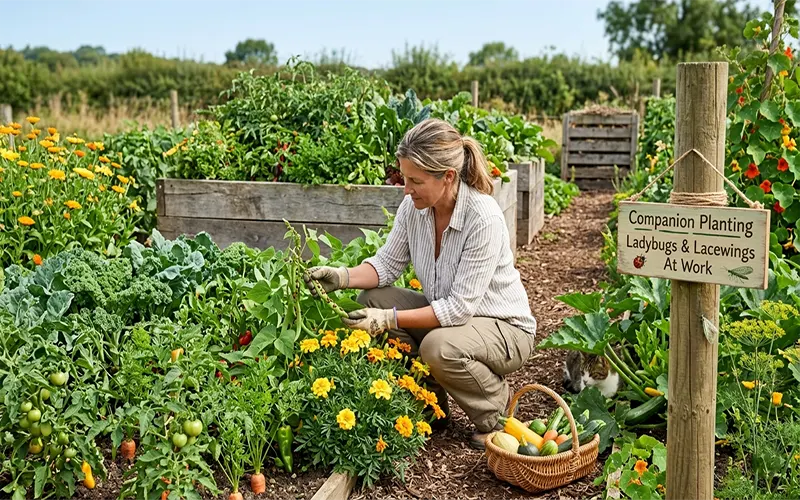
- Companion Planting: This secondary security system, also known as intercropping, uses natural scents and root exudates to protect crops. For example, marigolds can deter root-knot nematodes, while the strong scent of basil can mask tomatoes from searching pests.
- Crop Rotation: By moving plant families—such as Nightshades or Brassicas—to new beds each year, you disrupt the life cycles of soil-borne pests waiting for their favorite host.
Biological Warfare: Recruiting Beneficial Insects
In a balanced garden, every pest has a predator. The most effective way to manage aphids, mites, and scales is to invite the “Good Guys” to the feast.
- The “Good Guys”: Ladybugs are famous defenders capable of consuming thousands of aphids, while Hoverflies and Lacewings are equally vital for their predatory efficiency.
- Parasitic Wasps: These tiny, non-stinging insects lay eggs inside pests like the tomato hornworm. As the larvae develop, they consume the host from the inside out, ending the infestation before it spreads.
- Attracting Predators: To keep defenders in your garden, you must provide “insectaries”—clusters of flowers like dill and yarrow that provide necessary nectar. You can also build a “Beetle Bank,” which is an undisturbed patch of native grasses and pollen-rich flowers that serves as a permanent habitat for ground beetles and spiders.
Physical Barriers and Traps
Sometimes the simplest solution is mechanical rather than biological.
- Floating Row Covers: These lightweight, breathable fabrics prevent egg-laying insects, like the Cabbage White butterfly, from reaching your plants.
- Copper Tape and Diatomaceous Earth: Diatomaceous Earth (DE) is a mechanical deterrent made of fossilized algae; it is harmless to humans but dehydrates soft-bodied insects with its microscopic sharp edges. Copper tape is an effective deterrent for slugs and snails.
- Traps: Beer traps can be used to manage slugs, while other mechanical methods like a strong blast of water or hand-picking are effective for aphids and hornworms.
Kitchen-Safe Remedies: DIY Sprays & Solutions
When predators and barriers are not enough, you can turn to pantry-safe solutions.
- Neem Oil: Known as the “Swiss Army Knife” of organic gardening, it disrupts the hormonal systems of insects so they stop feeding and breeding.
- Garlic and Chili Sprays: These use spicy oils to make your plants unpalatable to munching invaders.
- Castile Soap Solutions: A simple mix of one tablespoon per gallon of water disrupts the cell membranes of soft-bodied insects like spider mites, causing rapid dehydration without leaving toxic residue in the soil. Always test these on a single leaf first to ensure they do not cause leaf burn.
The Long Game of Organic Gardening
Organic gardening is about playing the long game by fostering biodiversity and respecting the soil to create a garden that protects itself. This chemical-free approach ensures your vegetables are as safe for essential pollinators like bees as they are for your dinner table. Though it requires more observation, the reward is a vibrant, living space that thrives in harmony with nature.