
The Underground Engine: Why Soil is Your Most Important Input
To the uninitiated, the ground beneath our feet is simply “dirt.” To the master gardener, however, soil is a complex, living ecosystem—an underground engine that powers every leaf, flower, and fruit in the garden. There is a direct, scientific correlation between soil health, the nutrient density of your vegetables, and your overall crop yield. Healthy soil provides the structural support, water-holding capacity, and bioavailable nutrients that plants need to thrive. In the quest for a record-breaking harvest, “guessing is not a strategy.” Relying on visual cues alone often leads to over-fertilizing or missing critical deficiencies. Data-driven gardening, starting with a clear understanding of your soil’s chemical and physical makeup, is the only way to ensure your garden reaches its maximum potential.
Deciphering Your Dirt: Methods of Soil Testing
Before you can improve your soil, you must understand its current state. There are several methods to decipher the secrets of your substrate:
- The Professional Lab Test: Sending a sample to a local university extension office is the gold standard of gardening. These tests provide precise data on NPK levels, micronutrients, and Cation Exchange Capacity (CEC)—a measure of your soil’s ability to hold onto nutrients.
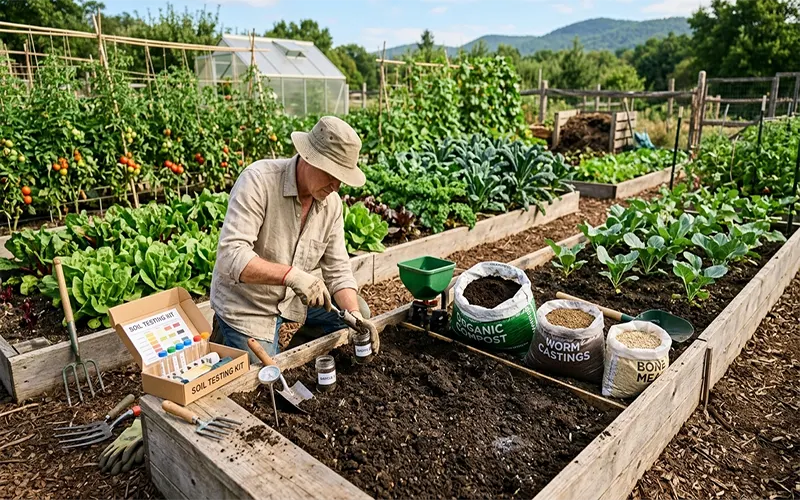
- The DIY Home Kit: Retail kits are excellent for quick, anecdotal checks of pH and primary nutrients. While less precise than a lab, they offer immediate feedback for mid-season adjustments.
- The Mason Jar Texture Test: You can determine your soil’s “tilth” at home. Fill a jar one-third with soil, add water, shake, and let it settle. The resulting layers of sand (bottom), silt (middle), and clay (top) reveal your soil’s physical composition.
- The Percolation Test: Dig a hole 12 inches deep, fill it with water, and let it drain. Refill it and measure how quickly it empties. Proper drainage is vital; “wet feet” caused by poor drainage can suffocate roots and ruin root crop harvests.
Pro Tip: Collecting a Clean Sample
For the most accurate results, collect soil from 6–8 different spots in your garden at a depth of 6 inches. Mix them in a clean plastic bucket. Avoid using metal tools or containers, as they can leach trace minerals into the sample and skew your data.
Understanding the Numbers: pH and the Big Three
Soil chemistry revolves around the “Big Three” macronutrients and the pH scale, which acts as the gatekeeper for nutrient availability.
- The pH Scale: Most vegetables thrive in the “sweet spot” of 6.0 to 7.0. If soil is too acidic or too alkaline, nutrients become chemically locked away, regardless of how much fertilizer you add.
- Nitrogen (N): The engine of leaf and stem growth. High-nitrogen levels are essential for leafy greens but can inhibit fruit production if unbalanced.
- Phosphorus (P): Critical for root development and the energy transfer required for flower and fruit production.
- Potassium (K): Enhances overall plant vigor, disease resistance, and water regulation.
- Trace Minerals: Don’t ignore the supporting cast. Calcium builds strong cell walls (preventing blossom end rot), while magnesium is the central atom in the chlorophyll molecule.
Quick Guide to N-P-K
| Nutrient | Function | Visible Deficiency |
| Nitrogen | Leaf/Green Growth | Yellowing older leaves |
| Phosphorus | Roots/Flowers | Purple-tinted foliage |
| Potassium | Strength/Water | Burnt or curling leaf edges |
Amending for Success: Correcting the Balance
Once you have your data, it is time to build a custom amendment strategy.
- Organic Matter: This is the universal fix for almost all soil woes. Adding high-quality compost, well-rotted manure, or leaf mold improves soil structure, feeds beneficial microbes, and increases water retention in sandy soils or aeration in clay.
- Adjusting pH: If your soil is too acidic, a measured application of lime will raise the pH. If it is too alkaline, elemental sulfur or peat moss can help lower it.
- Natural Fertilizers: Target specific needs with organic inputs. Use blood meal for a nitrogen boost, bone meal for phosphorus, or greensand for a slow-release source of potassium and trace minerals.
- Cover Crops: Often called “Green Manure,” planting clover or vetch in the off-season fixes nitrogen into the soil naturally while protecting the surface from erosion.
Implementation: The Best Time to Amend
Timing is everything in soil management. The “Fall Prep” advantage is significant; applying slow-release amendments like lime or compost in autumn gives them months to break down and integrate into the soil structure before spring planting. When applying these materials, consider the “No-Till” philosophy. While tilling can incorporate amendments quickly, it often disrupts fungal networks and soil structure. Whenever possible, “Top Dressing”—laying amendments on the surface and letting earthworms do the work—is the best way to preserve the long-term health of your soil’s microbial activity.
The Long-Term Investment
Building exceptional garden soil is an ongoing process, not a one-time event. It requires patience, observation, and a commitment to feeding the soil rather than just the plants. By testing regularly and amending thoughtfully, you aren’t just growing vegetables; you are cultivating a legacy of fertility. Remember: great gardens are grown from the ground up.